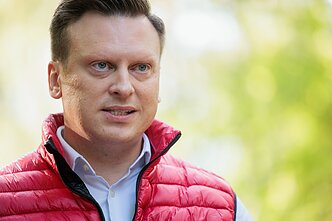















Vilnius Mayor Valdas Benkunskas has made migration a key issue in the second half of his term, but his claims about a “tipping point” for foreign residents have drawn criticism from experts.
Benkunskas has argued that when foreigners make up around 10% of a city’s population, the risk of forming segregated communities or “ghettos” increases.
“What research shows, including by scientists, is that there is a tipping point – if the state manages it, things are fine, but if not, ghettos begin to form,” the mayor said at a media conference earlier this month.
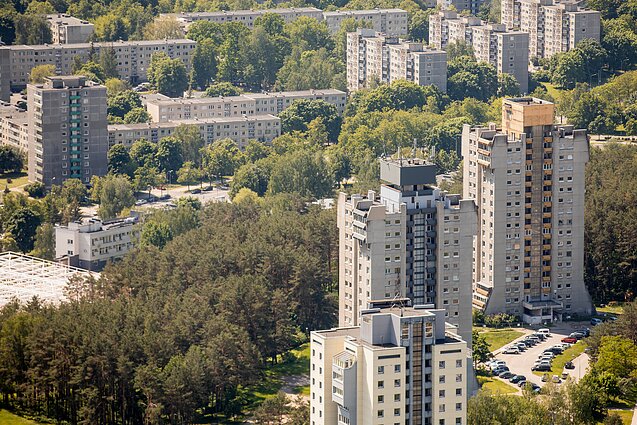
According to municipal data, Vilnius has about 641,000 residents, including roughly 61,000 foreign nationals – or 9.5% of the population, a three-fold increase from six years ago.

The mayor has warned that this growth could lead to social challenges such as higher crime, lower incomes and segregation in certain districts if integration efforts are insufficient.
However, when asked to provide studies supporting the 10% threshold, Vilnius city authorities did not cite specific research. Instead, they said the figure was mentioned during a discussion between Migration Department Director Indrė Gasperė and academics at an immigration conference.
The Migration Department later clarified that the idea emerged in an informal conversation and reflected an opinion rather than a conclusion based on scientific research.
A review of academic databases also failed to identify studies supporting a universal 10% threshold.
Sociologist Karolis Žibas, a research and policy adviser at the Diversity Development Group, said the mayor’s claim lacks empirical backing.
“The argument about a ‘10% tipping point’ is not supported by identifiable scientific literature. International research does not point to any universal threshold,” Žibas said.

He added that segregation in cities depends on a range of factors unrelated to a fixed share of foreign residents, including housing markets, income inequality, labour market access, education systems and discrimination.
“In other words, it is the result of urban and national policies and socioeconomic structures, not a simple demographic threshold,” he said.
Žibas also noted that there is currently no clear evidence of ghetto formation in Vilnius. Many foreign residents in the city are temporary workers or students, making long-term segregation less likely.
He cautioned against comparing Vilnius with cities such as Berlin, Stockholm or Paris, where migration patterns have been shaped by different historical and political factors, including colonial ties and refugee flows.
“Vilnius currently fits more the model of a labour migration city, characterised by higher mobility and less permanent territorial concentration,” he said.
The debate comes as the city rolls out integration measures, including Lithuanian language training for newcomers.
Benkunskas has said the rising number of foreign residents is a “serious signal” requiring action and warned that without effective integration policies, Vilnius could face social issues seen in some Western European cities.
Researchers, however, warn that public debate on migration in Lithuania is increasingly framed in terms of threats rather than data.
“Our media monitoring shows a clear trend – public discourse is dominated by terms like ‘tipping point’, ‘ghettos’, ‘influx’ and ‘control’,” Žibas said.

Newsletter
Every Friday morning.